
Most of us never sat our children down for a lesson about money. They learned it anyway, at the kitchen table, by watching us. They noticed what we bought, what we worried about, and what we quietly gave away.
I have thought about that a good deal over the years, both as an economist and as a person of faith. In my experience, the most important thing a child can learn about money is not how to earn it or even how to save it. It is what money is for.
Some years ago I wrote a short piece for parents about raising children who look outward and stand up for other people. I have come to think that kind of change starts small and close to home, and that money is one of the best places to practice it.
Start With a Plain Definition
Words have real meaning, so let's define the one that matters here. Stewardship means taking good care of something that has been entrusted to you. The owner is someone else, and you answer for how it was used.
I believe everything we have is entrusted to us for a season. That includes our income, our skills, our time, and even the table our family gathers around. Once a family sees it that way, the conversation about money changes. It is no longer only "What do we want to buy?" It also becomes "What is this for?"
For Such a Time as This
The Bible gives us a picture of this in the story of Esther. She was an orphan who became queen of Persia, a position she never planned for. When her cousin Mordecai urged her to speak up for her people, he asked whether she had come to her royal position "for such a time as this" (Esther 4:14).
Esther did not choose the palace. Mordecai's question was not really about power. It was about purpose, and it asked what that position was for.
I find that a helpful question for any family to ask about what it has been given. The point is to open a conversation, not to stir up guilt. Most of the time the answer is not dramatic. It looks like a neighbor, a church, or a cause close to home, and it often begins with simply being a good neighbor.
A Family Table Exercise
Years ago I suggested a simple exercise to parents, and I have adapted it here for stewardship. Set the phones aside, gather everyone at the table, and work through three steps together.
- Name the people. Each person writes down someone they know who could use help. It might be a friend, a relative, a widow down the street, or a ministry your family already trusts. Let the children go first, because their answers can be surprising.
- Name what you have. Ask what your family could offer. It might be time, a skill, a meal, a ride, or a gift of money. Even small children can contribute something.
- Choose one thing. Pick one small act, put it on the calendar, and decide together. Then talk about how it went when it is done.
These conversations can run deeper than you expect. Where does the first part of our income go? Who decides? And what is it for?
Let the Numbers Teach, Too
Values are easier to hand down when they have a shape. Years ago I settled on a simple formula, and I have not needed a better one. I call it 70-10-10-10.
Give the first 10 percent of any income away. Save 10 percent for something you want in the near future. Set aside the last 10 percent for the long term, and leave it alone. What remains is the 70 percent you live on.
The order matters more than the amounts. If we wait to give until everything else is paid for, there is often nothing left to give. Generosity works best as a plan, not a leftover.
Here is how it looks in a child's hands. Imagine a teenager earns $100 from a weekend job. Ten dollars goes first to a person or cause they care about. Ten goes toward a goal they have chosen, and ten is set aside for much later. The remaining $70 covers what they would otherwise spend. (Expect your teenager to point out that the 70 is smaller than they would like.)
Your family's numbers will differ, and a young person can start with far less. This is simply how I handle my own household, not a plan anyone has to copy. The lesson is that giving comes first, even when the amount is small.
More Questions Worth Asking
Once the exercise has opened the door, a few more questions can keep the conversation going over the following weeks.
- What are we saving for, and who else might it help someday?
- When something we hear about money sounds urgent, how do we check it before we react? (I share the habits I use in the six warning signs I watch for.)
- What is one generous thing we could do this month that stretches us a little?
Small Steps Count
Doing the right thing can cost us something. It is often easier to follow the impulse that feels good in the moment than to make a plan to give. Children notice which one we choose when it is not convenient.
You do not need a large income or a perfect plan to begin. A family that learns, one small act at a time, to ask what its resources are for is giving its children a good place to start.
So who is the first person your family would write down?
Keep the Conversation Going
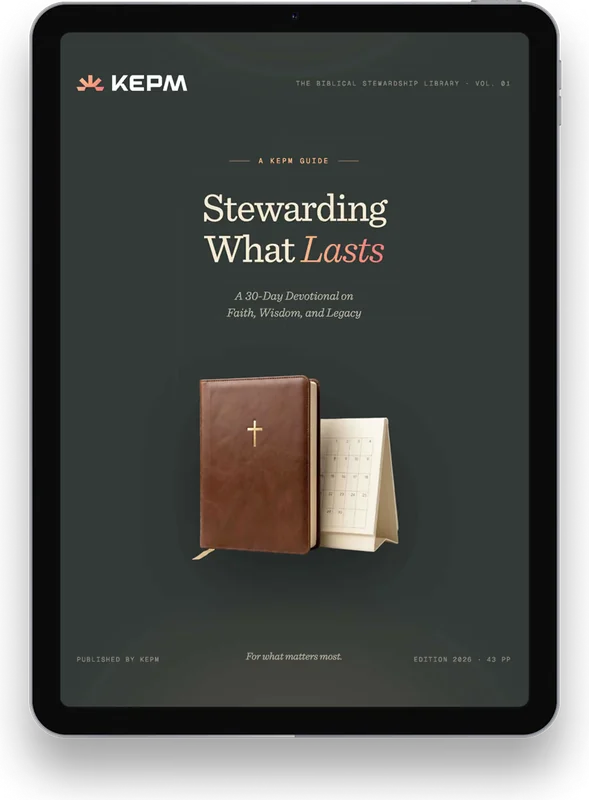
If this reflection spoke to you, Stewarding What Lasts is a good place to continue. It is our 30-day devotional on faith, wisdom, and legacy, with a Scripture, a short reflection, a practical step, and a prayer for each day.
Disclosures
This article is a personal stewardship reflection. The 70-10-10-10 formula describes how Dr. Kirk handles his own household, and your numbers will differ. KEPM cannot provide tax, legal, or investment advice. Individuals should consult their own tax, legal, or financial professionals for guidance specific to their situation.
Know more, own better
Get real knowlegde on gold, silver, and the decisions surrounding them.

Not Sure Where to Begin? Start Here.
Before you buy a single ounce, it helps to understand the fundamentals.
The Bullion Blueprint is Dr. Kirk Elliott's plain-language guide to owning physical gold and silver: how bullion works, how honest pricing works, and how to protect what you've built.